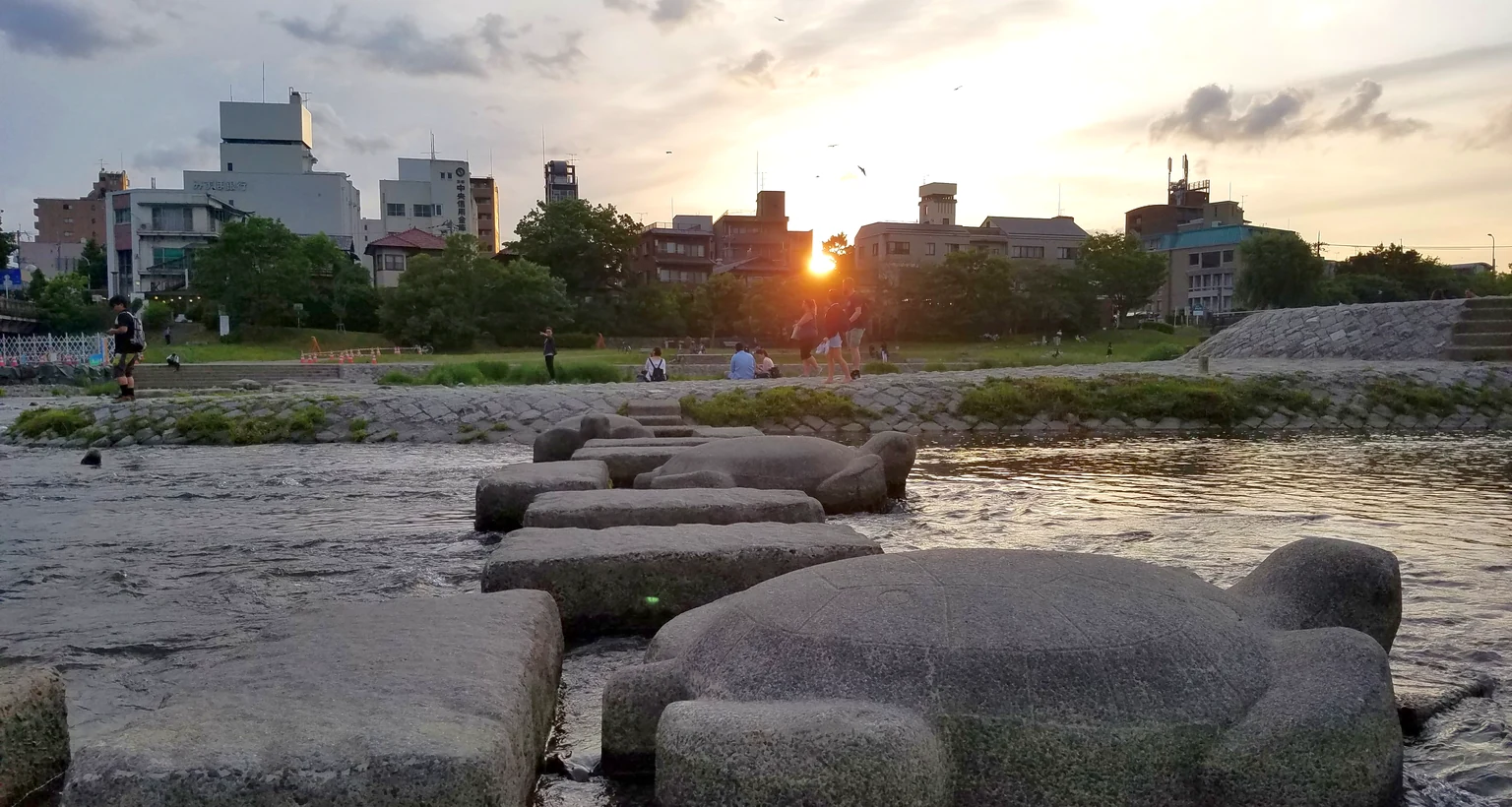
Around Demachiyanagi, where the Kamo and Takano rivers meet—a waterside landscape that symbolizes life in Sakyo.
Photo: Hajime NAKANO / Wikimedia Commons / CC BY 2.0(cropped and brightness adjusted)
The Appeal of Sakyo Ward:
Living Guide
The Kamo River, the Higashiyama mountains, university campuses, distinctive restaurants and cultural venues: Sakyo changes so much from neighborhood to neighborhood that there is no single definition of 'Kyoto-like.' Here we look at Sakyo not as a sightseeing area, but as a place to live every day.
Sakyo's appeal is having urban convenience and nature close at hand within the same daily living area.
Sakyo is a large ward covering much of northeastern Kyoto City. The south is urban, with universities, homes and shops, while farther north the scenery shifts dramatically toward mountains and rural communities such as Iwakura, Ohara, Kurama and Hanase. Kyoto City itself describes Sakyo as having distinct southern urban, central mixed urban-rural, and northern mountain-rural zones.
Walking, jogging, cycling, or simply sitting down for a break: around Demachiyanagi, the Kamo River is not a park you make a special trip to—it is part of the route of daily life.
The ward is home to Kyoto University, Kyoto Institute of Technology and other universities, while museums, libraries and other cultural facilities cluster around Okazaki.
Demachiyanagi, Tanaka, Kitashirakawa and Ichijoji are easy to connect by bicycle. When choosing a home, it is worth judging bicycle routes as well as distance to stations.
Even within Sakyo, the student-town feel of Demachiyanagi, the residential character of Matsugasaki, and the environments of Ohara or Kurama are entirely different. The neighborhood matters more than the ward name alone.
1. Start with five key living areas in Sakyo
出町柳・下鴨南部
A transfer point between Keihan and the Eizan Railway, this area offers convenient travel to central Kyoto and toward Osaka. With the Kamo River Delta nearby, it suits people who want both open riverside space and strong transportation. It works well not only for students but also for singles who value city-center access.
田中・元田中
Close to universities yet more residential than the area right around Demachiyanagi Station, this district works especially well for a bicycle-based lifestyle. Commuting to campus, shopping and dining options can be combined while balancing rent.
Kitashirakawa
Closer to the foot of Higashiyama, this area brings greenery and mountains into daily view. It connects naturally toward Kyoto University and Kyoto University of the Arts and suits people whose lifestyle revolves around campus, bicycles and buses rather than proximity to a rail station.
一乗寺・修学院
Along the Eizan Railway, restaurants and everyday shops are scattered through a neighborhood with a strong lived-in feel. It combines student-town energy with residential calm, making it worth considering even for people who want to remain in Sakyo after graduation.
Matsugasaki / eastern Kitayama
The major advantage is access to the Karasuma Subway Line. It suits people who want Sakyo's greenery while traveling by subway toward Shijo and Kyoto Station. This is a quieter, more residential side of Sakyo than the student districts.
| 生活圏 | Best for | Main transport | Neighborhood feel |
|---|---|---|---|
| Demachiyanagi | Want both transport convenience and riverside life | 京阪・叡電・自転車 | 学生・交通・水辺 |
| 田中・元田中 | Close to campus while watching living costs | 自転車・叡電 | A lived-in student neighborhood |
| Kitashirakawa | Prioritize access to campus and nature | Bicycle / bus | Residential area near the hills |
| 一乗寺・修学院 | Prioritize dining and everyday convenience | 叡電・自転車 | Distinctive yet everyday |
| Matsugasaki | Prioritize subway access | 地下鉄・自転車 | Quiet residential area |
2. If you want to live somewhere 'Kyoto-like,' Sakyo offers something different from tourist districts.
Sakyo contains famous sites such as Ginkaku-ji, Nanzen-ji and Shimogamo Shrine, but its appeal as a place to live goes beyond temples and shrines. Crossing the Kamo River in the morning, eating near campus, or heading to Okazaki or Kitayama on the weekend makes history and culture part of ordinary movement rather than something reserved for planned visits.
On the other hand, areas farther from stations or closer to the hills require checks of nighttime streets, slopes, bus frequency and shopping distance. Do not rely only on attractive photos—walk your daily routes both in the morning and at night.
3. Five things to check when viewing a home in Sakyo
- 自転車置場. In many areas, bicycle access matters more than the nearest station.
- 坂道. Toward the east and the hills, elevation differences may not be obvious on a map.
- Nighttime route home. Check pedestrian traffic at the times you would return from university or a part-time job.
- Distance to the supermarket. Everyday shopping routes may matter more than distance to the nearest station.
- Distance from rivers and mountains. Check disaster-prevention information for heavy rain, not just the scenery.
Find the part of Sakyo that fits your life
Demachiyanagi or Ichijoji? Close to campus or close to the subway? Because Sakyo is far from uniform, it makes sense to narrow down properties based on how you actually want to live.
Ask about housing →